Find your study routine, meet people and get to know the city, its culture and its language.
Main advice stays visible. These buttons control extra explanations.
☕
Places to study without overstaying
Laptops are normal in several Galway cafés, but a café table is not an all-day desk. For a focused hour or two, buy something and be mindful of the queue and how busy the room is. For a long session, use a library or your college’s study spaces.
Caffè Nero, Eyre Square
Central, spacious and used to seeing laptops. Good when you are waiting for a bus or need a short city-centre session. Buy a drink, avoid spreading across a large table and do not assume one purchase covers several hours.
An Tobar Nua
A friendly canalside café where laptops are welcome. It is a pleasant daytime option for reading or lighter work, but stay aware of lunch traffic and free the table when the café needs it.
Galway City Library
Galway City Library in Hynes’ Building on Saint Augustine Street has dedicated study space and is the better free option for a longer session. Join the library—it is free—and check that day’s hours before travelling.
Your college library
University of Galway, ATU and other campus libraries are designed for sustained work and usually give enrolled students quiet areas, group spaces, Wi-Fi and power. Some buildings or periods require student ID.
Good café-study etiquette
Buy something, and buy again if you stay for another round of work.
Aim for roughly one to two hours when it is quiet; leave sooner if tables are filling.
Use the smallest table available and keep your bag, charger and coat out of other people’s space.
Check closing time before settling in—many Galway cafés close earlier than students expect.
Keep calls short and use headphones; a café is shared space, not a private office.
College support: ask before a small problem becomes a crisis
You do not need to know which office has the answer. Start with student services or your students’ union and explain what is happening.
Start with your campus library for a longer study session.Read the practical stepsClose the practical steps
University of Galway
Student Support Officers can discuss personal, academic and financial problems. The university also provides counselling, disability support, international support and accommodation advice.
ATU Galway-Mayo
Use the ATU Student Hub, select your campus and ask student services for the appropriate counselling, access/disability, accommodation or financial-support contact. Some services require your student login.
Money is running out
Ask about hardship or financial-assistance options early. Explain your rent, food and transport costs and have supporting records ready. Eligibility and funding differ; an application does not guarantee an award.
Study is becoming difficult
Talk to your lecturer, programme office or support team before deadlines pass. Ask about learning support, reasonable accommodations or the relevant extension process. You may need documentation.
Your students’ union can help you navigate an unfamiliar process and raise concerns. Counselling and support appointments have their own availability and confidentiality arrangements—ask how the service works.
Student discounts in Galway: useful savings, not extra spending
Carry a valid student ID and ask before paying. A discount only helps if the final price beats the alternatives and you needed the purchase anyway.
Read the practical stepsClose the practical steps
Boots · 10% on eligible purchases
Boots Ireland offers a student discount through its Advantage Card. Activate it at a manned till using valid student ID and reactivate each academic year. Exclusions apply; read the current terms.
IMC Galway · student tickets
IMC offers student-rate cinema tickets with valid, in-date student ID. Compare the price for your screening with other available ticket offers; no fixed saving is promised here.
UNiDAYS and Student Beans
Use the Ireland versions, verify your student status and check whether each offer applies online, in-store or both. Discounts, brands and exclusions change regularly.
Transport and campus services
Check the guide’s Leap Card advice for the age-based or student option that suits you. Before paying for software, printing or sports elsewhere, see what your college already provides.
Ask cafés, shops and gyms whether there is a current student rate; verify it rather than assuming one.
Check ID requirements, exclusions, delivery charges and whether codes combine with a sale.
Student ID, Student Leap, UNiDAYS and Student Beans are different forms of verification; each business decides what it accepts.
Galway’s Meetup scene is smaller than Dublin’s, but there are usually a handful of welcoming groups and events around social activities, hiking, technology, languages, games and outdoor life. It can be a good way to meet people outside your course.
Free Meetup versus Meetup+
The free account is enough for most students. You can search for groups, join them, find events and RSVP without paying. If a Meetup+ pop-up appears, choose Continue with free plan.
Meetup+ probably is not worth paying for unless the attendee information matters to you. The paid version gives fuller access to attendee lists and profiles, which may help you get a rough sense of the gender, age or general social mix before attending. Treat that only as an impression: profiles are self-selected, may be incomplete and are not a reliable demographic count.
Other Meetup+ extras include unrestricted member messaging, earlier event announcements, priority on eligible waitlists, removal of Meetup service fees on paid-event RSVPs and an ad-free experience. None of these is required to attend normal events.
Meetup+ is also separate from any fee charged by an individual group or event. If you start a trial, note the renewal date and cancel before it ends if you do not want the subscription.
Making the first event less awkward
Choose an event with a clear activity—walking, a language exchange, board games or a talk—rather than relying on unstructured networking.
Check the recent event history and attendee comments so you know the group is active.
Tell someone where you are going, meet in a public place and arrange your journey home before the event starts.
If the first group is not your crowd, try another. Galway’s groups vary enormously in age, interests and atmosphere.
Irish people often turn greetings into questions. You are not expected to deliver a detailed health report in a doorway or at a till—a short, friendly answer is usually enough. Meanings and expressions vary by person and place, but these will get you through everyday Galway.
“How are you getting on?”
Meaning: How are things? How is life going?
Easy reply: “Grand, thanks. Yourself?”
“Are you okay?”
From café or shop staff, this often means “Are you being served?” or “Do you need anything?” It usually does not mean you look unwell.
“What’s the craic?”
Craic—pronounced “crack”—means fun, news, chat or the general atmosphere. “Any craic?” can simply mean “What’s happening?”
“Grand”
Usually fine, okay or acceptable—not necessarily magnificent. “That’ll be grand” means the plan is probably settled.
“Sound”
A sound person is decent or reliable. “Sound” on its own can mean good, agreed, or thanks: “You sent the notes? Sound.”
“Giving out”
Complaining or scolding—not distributing something. “The landlord was giving out” means the landlord was annoyed and saying so.
“Your man / your one”
An informal way to refer to a man or woman whose name is forgotten, unknown or obvious from context. It does not normally imply a relationship to you.
“I’m after…”
In Irish English, “I’m after losing my keys” means “I have just lost my keys,” not that you are chasing them.
Small customs that prevent awkward moments
Return the greeting. “Grand, thanks—yourself?” is enough. Long answers are welcome among friends, but not required at every counter.
Rounds are common in pubs. If you join a round, expect to buy one when your turn arrives. It is also fine to say at the start that you are buying your own.
Queue, even when the queue looks vague. Ask “Are you in the queue?” rather than stepping ahead.
Thank the bus driver. A quick “thanks” when getting off is common.
Tipping is modest, not American-style. Check whether service is included; rounding up or leaving roughly 10% for good table service is appreciated but not compulsory.
Weather talk is useful social glue. It is a safe opening, not evidence that nobody has anything better to discuss.
“No” may be softened. “I will, yeah,” “maybe,” or “we’ll see” can depend heavily on tone and context. Confirm dates and practical commitments directly.
One phrase to handle carefully: in Ireland, “a ride” can have a sexual meaning. Use “a lift” when asking someone to take you somewhere by car.
Six approachable picks for Irish language, history, travel, food and the highly specific challenge of addressing your pet in Irish. This is intentionally a short shelf—not an online bookshop.
As an Amazon Associate I earn from qualifying purchases.
History + languageA History of Ireland in 100 WordsArbuthnot · Ní Mhaonaigh · Toner
A surprisingly readable route into Irish history through the words people used.
Galway city-centre food adds up quickly. The best-value routine is usually a supermarket or campus lunch, cooking most evenings, and saving takeaways for when they genuinely solve a problem.
Five places I’ve eaten and recommend
Start with the dish and the price, rather than assuming everything on a menu is cheap. A slice or soup is a lighter bite; a burrito or whole pizza is a different kind of meal.
Lil’ Bros
Lighter bite · €4.75–€4.95 NY-style pizza by the slice: tomato €4.75 or cheese €4.95. An easy stop when you want a quick bite without buying a whole pizza.
Whole pizza · €12 A 12-inch Margherita is listed at €12. A useful whole-pizza option in Eyre Square Shopping Centre; toppings, dips and drinks add to the total.
Example prices checked against the venues’ published menus on 19 October 2026. Prices can change; drinks, delivery and extras may cost more. Compare the direct collection price before ordering through a delivery app.
Lowest-cost routine
Use Aldi or Lidl for packed lunches; check Tesco meal deals and supermarket deli counters; bring your student card to campus cafés and canteens; carry a bottle and snacks so hunger does not become an expensive delivery order.
Quick and filling
Xi’an Street Food is a dependable counter-service option. Pizza & Pasta Napoli, beside Tigh Neachtain on Cross Street, is handy for pizza by the slice. McDonald’s can be cheaper than Supermac’s when price is the deciding factor.
Late after drinks
Nut Hot is the classic no-seats Chinese takeaway, with taxis across the street. Yummy Wok on Headford Road is another useful Chinese takeaway. Order directly or collect when practical.
Other student-friendly choices
An Tobar Nua: a warm canalside café for breakfast, soup, sandwiches, bagels and wraps. It is friendly and comfortable rather than a late-night option.
Chippers: McDonagh’s is the well-known city-centre institution; Giovanni’s and neighbourhood chippers can be useful for a filling collection order. Compare menus because fish and chips is not always the cheapest item.
The Dough Bros: excellent pizza just off Shop Street, but think of it as a good-value treat rather than the absolute cheapest dinner.
Too Good To Go: useful for discounted Surprise Bags from cafés, bakeries, restaurants and shops. Great value when you are flexible; useless when you need one specific meal.
Student specials: check the window, website and direct-order price. Some deals require valid student ID and may not appear on delivery apps.
How to avoid spending €20 on a “cheap” dinner
Compare collection with delivery. Service, delivery and small-order fees can cost more than the supposed discount.
Do not assume a combo is cheaper. Price the main item, tap water and only the side you actually want.
Reserve Too Good To Go bags early, but read the collection time before paying.
Keep one easy meal at home—pasta, frozen food, soup or noodles—for evenings when everything feels too far away.
You can have a good Galway day without buying a ticket. Start with these reliable options, then check current listings for something new.
Read the practical stepsClose the practical steps
Galway City Museum
Admission is free. Check current exhibitions and opening hours before visiting, especially around holidays.
Galway Arts Centre
Gallery admission is free. Check for installation closures and browse the programme for free Gallery Lates events; individual workshops or performances may have separate booking rules or charges.
Salthill Promenade and Blackrock
A seafront walk is an easy free outing. Bring a weather layer and choose conditions that suit a coastal walk. You can enjoy Blackrock without swimming or jumping in.
Library and campus activities
Look for library events, public talks and club or society activities. Check whether a listing is open to everyone, students only or members, and whether booking is required.
Looking for upcoming events? This guide does not maintain live event listings. Use the museum, arts-centre and campus calendars below for current events, and check the date, admission fee, booking requirement and location directly with the organiser.
A simple free route: the museum and Spanish Arch, a walk through the Claddagh, then Salthill Prom if the weather suits. For a shorter wet-weather plan, try the museum and a gallery.
You can build a full day around the city and Salthill for the price of coffee or lunch. Wear waterproof layers and shoes, because the route is exposed once you reach the Prom.
Galway City Museum: start beside the Spanish Arch. Admission is free and no booking is normally required.
Galway Arts Centre: walk through the West End to 47 Dominick Street. Entry to the galleries is free; Thursday Gallery Lates often run free evening events.
Salthill Prom: continue west along the coast. The walk itself is free, flat and one of the best ways to understand the city.
Blackrock: finish at the diving tower, watch the swimmers and kick the wall at the end of the Prom—the local tradition.
Galway’s festival calendar gets wonderfully chaotic
Galway does not hold one neat festival season. Film, theatre, literature, horse racing, oysters, street spectacle and free cultural events repeatedly take over the city. That is part of the fun—but it changes traffic, accommodation prices, restaurant availability and how long an ordinary journey takes.
Spring
Cúirt International Festival of Literature brings readings, talks and performances. Smaller music, food and community festivals appear around the bank-holiday weekends, often with free street events.
July becomes festival month
The Galway Film Fleadh, Galway International Arts Festival and Galway Races arrive almost back-to-back. The city feels brilliant and extremely busy. Book tickets early and expect packed buses, pubs and accommodation.
September
Culture Night opens venues for a citywide programme of free music, theatre, visual art, heritage and community events. The Galway International Oyster & Seafood Festival also brings competitions, food and street activity later in the month.
Halloween
The Macnas Halloween parade is not a small community float parade. Expect enormous puppets, performers, sound, smoke and packed streets. It is one of Galway’s great free public spectacles.
How to enjoy a big Galway event without ruining your evening
Check the official route, time and date. Festival details can move, and unofficial listings are sometimes wrong.
Walk or cycle when practical. Road closures, full buses and taxi demand can make a short city-centre journey surprisingly slow.
For Macnas, arrive early and choose your viewing spot before the crowds compress along the route. Dress for standing outside in wind and rain.
Book restaurants, performances and any overnight accommodation early during the Arts Festival and Galway Races.
Do not assume “festival” means every event is paid. Culture Night, galleries, outdoor installations, parades and many street events are free.
Save the official programme to your phone, but leave room for something strange you discover while walking through town.
Coming up: Macnas marks its 40th anniversary with the free Fiáin Halloween parade in Galway on Sunday, 25 October 2026. Confirm the route and start time with Macnas before travelling.
Some are everyday stops; others are a treat. Check current menus and opening times before going. Bringing your own dog? Ask the venue about its current policy.
Leaving Galway: deposits, bills and the loose ends
Start planning several weeks before you leave. Your flight date does not automatically end a rental agreement, job or subscription.
Galway Arts Festival parade, archive photo from 2007 · Peter Clarke, CC BY-SA 4.0. Display crop.
Festivals coming up
Last checked: 19 October 2026. Monthly review; check the organiser for changes.
Loading the latest festival dates…
Read the practical stepsClose the practical steps
Check your rental exit requirements. Ask Threshold if unsure about notice, a fixed term or leaving early. Get agreements in writing; do not assume the deposit pays the last month’s rent.
Document the handover. Clean the room, photograph its condition, compare the inventory, return keys and record the agreed departure. Ask for the deposit return and an explanation of any proposed deductions.
Close or transfer accounts. Take final meter photos, contact suppliers, return broadband equipment and agree house-share bill balances. Keep final statements and proof of payments.
Cancel the things that renew. Check phone, gym, streaming and other subscriptions, including notice periods. Cancelling a direct debit alone may not end the contract.
Sell, donate or dispose of belongings early. Agree collections, confirm what charity shops accept and use proper waste facilities for the remainder.
Finish employment and review tax. Confirm payroll records your leaving date. A refund may be due if you worked for only part of the year; follow Revenue’s departure guidance and keep myAccount access.
Keep important access working. Update contact details and retain a way to receive verification codes. Keep banking available until refunds and final bills are settled. If returning to Ireland, check your immigration permission and re-entry requirements before travelling.
Some Irish undergraduate degrees are shorter than students from the US may expect, and many taught master’s programmes take one year. That can make Galway worth comparing on total time and total cost, not just one year’s tuition.
Years 1–3Bachelor of Commerce
University of Galway lists its BComm as a three-year Level 8 degree, with a four-year option.
This is simple arithmetic using one year’s posted rates—not a four-year quote. Fees can rise each year and this excludes rent, food, insurance, travel, books and other living costs.
Include health insurance, flights and visa or registration costs.
Check scholarships, financial-aid rules and annual fee increases.
A shorter route can save substantial time and money, but your own offer letters and housing budget are the only honest comparison.
After a qualifying Level 9 award
Up to 24 months to pursue graduate work
Eligible non-EEA graduates may receive 12 months under Ireland’s Third Level Graduate Programme and may renew for another 12 months if they meet the conditions. It is permission to seek graduate-level work—not a guaranteed job or permanent residence.
Facts and fees checked 10 October 2026. This is a worked example, not admissions, immigration or financial advice. Course length, eligibility and fees differ by programme and can change.
The place behind the practical advice
Galway, Gaeilge and a cheap flight away.
Galway is a compact Atlantic city with two universities, a year-round arts scene and Connemara at its doorstep. It feels distinctly Irish without making an international student learn a new language just to buy groceries, open a bank account or get through class.
EN
English gets you through daily life
English is the main everyday language across most of Ireland, so English-speaking students can study and settle in without a language barrier. Legally, Irish is the national and first official language; English is the second official language.
You will see Gaillimh for Galway and bilingual signs throughout the city. West of Galway, Irish is still a community language in the Connemara Gaeltacht and on the Aran Islands. You are not expected to be fluent, but interest and respect go a long way.
Dia dhuit — hello · Go raibh maith agat — thank you · Sláinte — cheers / good health
Low-cost one-way base fares from Ireland sometimes fall below €20. That makes Galway an excellent launch point, via Shannon, Dublin or Knock—but the headline fare may exclude a cabin bag, seat choice and the trip to the airport.
The scale is real: Irish residents took 15.1 million outbound overnight trips in 2025, according to the CSO. That is a count of trips, not 15.1 million different people.
Try Shannon, Knock and Dublin. Compare the full cost of baggage and getting to the airport; routes and fares vary by season.
EU does not mean border-free. Ireland is not in the Schengen Area. Check your passport, destination visa rules and permission to re-enter Ireland before booking—especially if you are a non-EU student.
Facts checked October 2026. Airfares are examples, not promises: compare the total after baggage, seat and airport-transfer costs.
The Galway you will actually use
Not stock Ireland. Real streets and everyday landmarks.
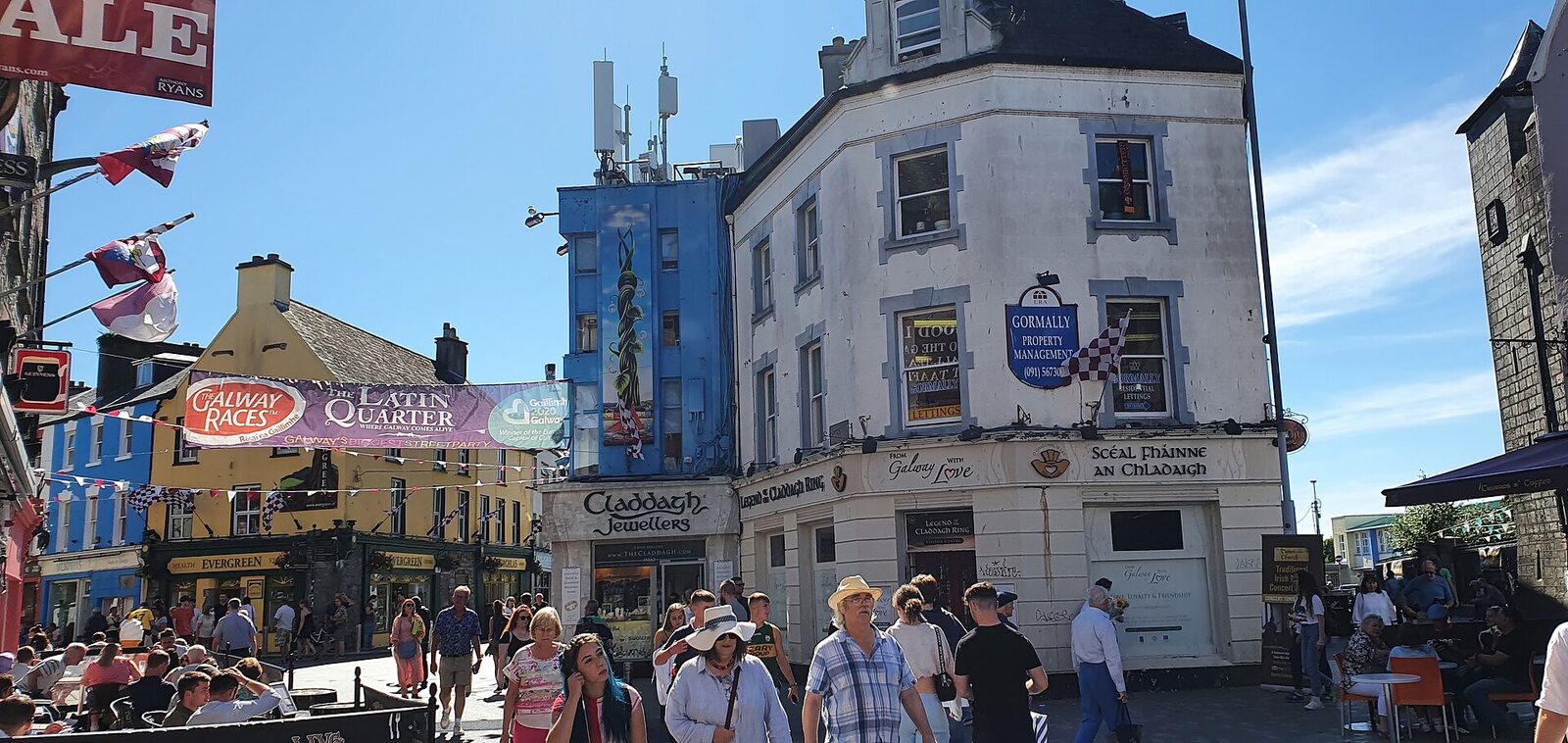
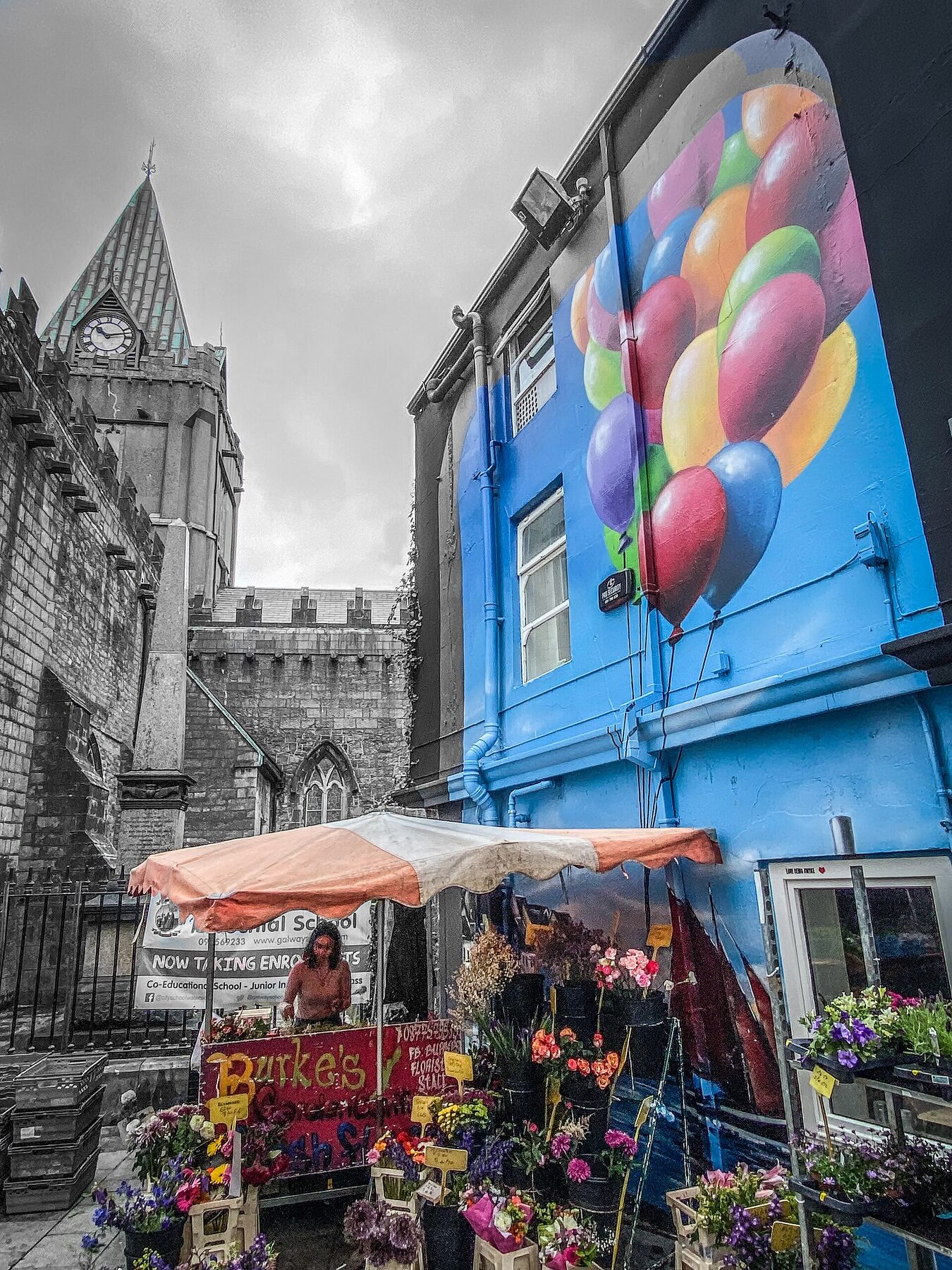
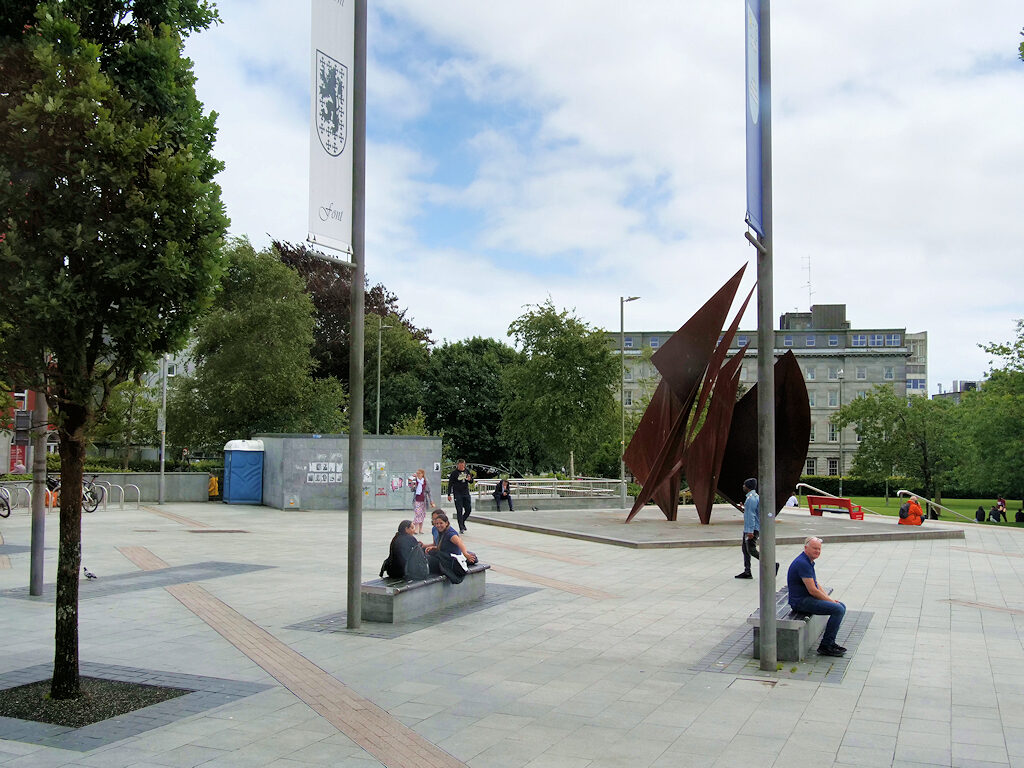
The Long Walk from the waterA Galway Hooker under dark sails.Photo: William Davis.Shop StreetWhere errands, buskers and meeting friends overlap.Photo: Yair Haklai, CC BY-SA 4.0; resized.Galway MarketA useful weekend stop beside St Nicholas’ Church.Photo: Dieglop, CC BY-SA 4.0; resized and cropped.University of GalwayThe campus is part historic stone, part very ordinary daily commute.Photo: William Murphy, CC BY-SA 2.0; resized and cropped.Eyre Square on a normal dayCentral, useful and sometimes exactly this grey.Photo: David Dixon, CC BY-SA 2.0; resized and cropped.